History and Origins of the Riverside.
The Riverside Chassis
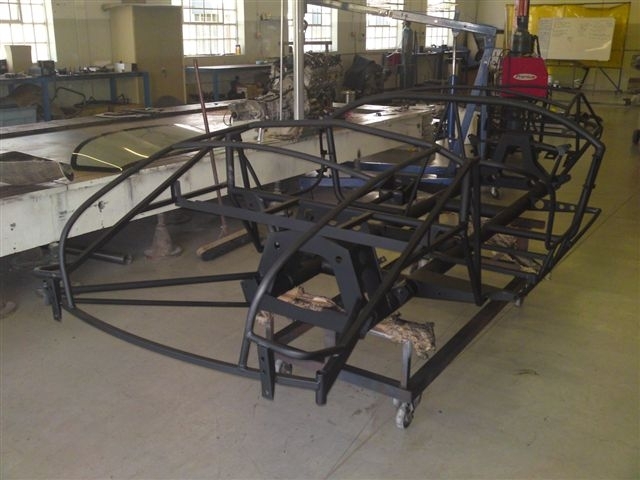
The John Tojeiro designed 3” tubular rail and cross member ladder style chassis, with front and rear suspension towers welded to it, started off life under a Cliff Davis 2-liter special in 1953. The little red Ferrari 166 barchetta look-a-like body placed on top of this chassis proved to be a formidable force in the local club racing events... so much so that AC cars decided to buy the design when it was offered to them. . The chassis was also tweaked by Alan Turner at the AC cars factory. Heavier gauge tubing with extra cross bracing was used and because the rear brakes had been moved from inboard to outboard, the differential area could be modified and strengthened as well. The first 126 frames used the same front suspension tower as the Ace but when the change to rack and pinion steering took place, a different type of front shock tower was used. This allowed for further strengthening.
To begin with, original AC drawings of the John Tojero designed chassis including tweaks made by Alan Turner dimensions were obtained and used. The necessary jigs were made and the first 3” pipes placed on the huge heavy metal table. Unlike the original, Arc and gas welding was not used. Instead Mig, Tig and computers made life simpler and better. Eventually, the prototype, Chassis RSR 2000 was eventually put together. Brackets for everything slowly found their way to their allocated places. To see all the tubes and little things like the nibble marks in the shock towers (there because in those days no laser or water jet cutting was available) was the proof that we were on the right track. The theory of “little things take a lot of time” proved correct. As this was not a one off project, every change had to be checked, noted and documented.Finally the jig was finalized and the first chassis RSR 2000 produced. The end product proved it was worth all the effort !..
The change from worm and sector to rack and pinion transformed the handling of these cars. At the same time the bottom control arm pick up points were able to be repositioned. Originally the 3" tubing was all arc welded whilst the body framework, consisting of ¾" and 1" steel tubing, was gas welded. 1 ½" tubing was used to strengthen the scuttle area. Today we use state of the art technology that has vastly improved on these methods, although hopefully none of the charm has been lost.
Another change for safety was to add an additional control arm pick-up point to the chassis in order to increase the shear strength of the bolt passing through the lower control arm rose joint or poly-bushed rod end. . This insistence on authenticity means that owners of a Riverside roadster will have virtually the same driving experience as the original.
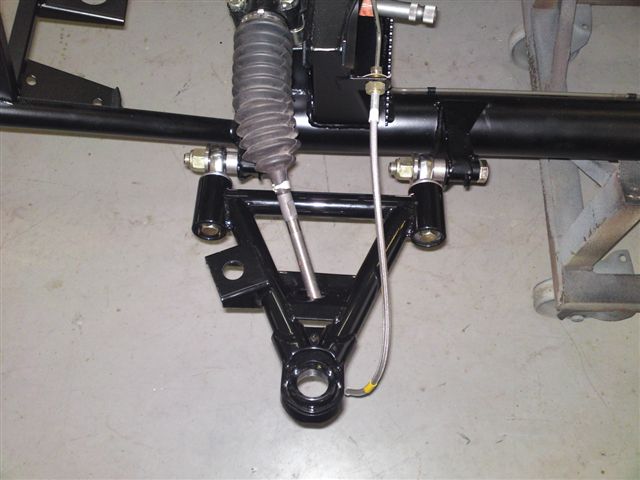
The same rule applied here. The suspension had to be period correct, or as close to as possible.
Because on a transverse leaf spring style suspension it requires different length springs to change camber settings, the decision taken was to go the rose joint way. As some competition cars had used this it was felt to be acceptable. Two options offered here. The first being rose joints and the second being adjustable rod ends with poly bushes. The poly bushes for those who want a slightly less hard feel and the rose joints for the racers.
Also another pick up point was added to the chassis to add shear strength to the bolt passing through the lower control arm rose joint .
The springs created somewhat of a problem as the steel thicknesses on the drawings were no longer available. It was decided to mill the available to the correct size and thickness which also added to the cost, but for the prototype we needed the yardstick to gauge against. . 10 blades in front and 8 blades in the rear. Because of the non availability of the correct thickness material after the first set was made and compression rates studied only 9 blades of thicker material are now used whilst the rear stays the same at 8 blades
New tooling for the trunnions and uprights were machined and then cast. Again lots of time but the end result most satisfying. These being cast in 17-4ph stainless for added strength and durability.
Pro shock absorbers made in the USA are used
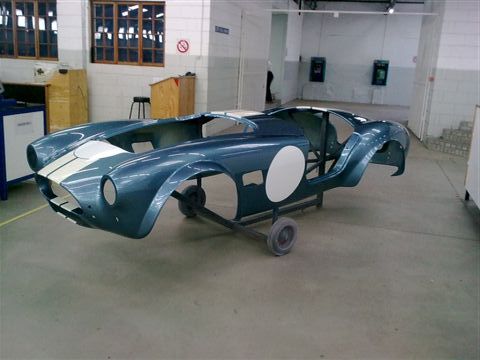
The Riverside replicates the European FIA regulated racers but produced in fiberglass. and has all the following mentioned features.
The race cars needed to get fuel into them quicker, so the larger Le Mans type filler was fitted. These were placed almost directly behind the passenger’s seat to enable easier pit refilling. On some cars to prevent fuel being sucked out and into the car at speed, a small wind deflecting shield was fitted in front of it. More fuel was also required, so a special long range racing tank was fitted into the boot ,which meant that there wasnt enough space in the boot for the FIA regulation size suitcase and for the boot lid to close two dimples were "engineered" (Legend has it that the first dimples were created by the aluminium boot lid being slammed on the luggage by a frustrated mechanic!) The reserve fuel switchover valve was placed on the floor between the drivers legs just in front of his seat.
The bonnet also got the treatment. The air scoop was shaped not riveted onto. Rivets appeared on the front of the bonnet to stop the aluminum from been torn off the frame at high speed. This was known to happen, the cause being a high pressure build up in the engine compartment. The fender air vents helped to solve that as well as removing excess hot air from the engine compartment. Fiberglass air scoops were fitted in three locations to feed cold air on to front and rear brakes as well as into the cabin foot boxes. The larger the tires, the larger the flares. So the rear and doors were modified to cater for these. Cut back doors and a more bulbous rear appeared. The front flares were stretched out to cover the tyres as well. Oil coolers on both motor and diff were fitted for obvious reasons. The diffs hot oil being circulated by a Bendix fuel pump! Rondel illuminating lights were fitted on the sides on some for night racing. A crash bar was fitted with a forward angled supportive tube brace bolted to the chassis in the passenger’s foot well. No carpets were fitted and all other trim was also removed.
The dash was also altered by leveling the two shorter sides on either side of the centre dropped section. This allowed the steering column to be dropped to give a more comfortable racing position as well as making enough space for the 3 3/8" Stewart Warner tachometer to fit above it. In this position it was more visible to the driver. The rest of the instruments were replaced by the larger 2 5/8" gauges and arranged differently on the dash. The bottom of the dash featured an upturned lip for strengthening which also helped cure scuttle shake problem. The speedometer was relegated to the passenger side. Strangely the grab handle remained, possibly to meet the FIA production regulations. Under the bonnet a race 260 or 289 SBF equipped with Weber’s was fitted and a Harrison radiator expansion tank, sourced from a 1963 Corvette was fitted above the transverse spring. Side exhausts exiting at the rear of the doors made the required noise. Each an every car differed in some way or other, but the above changes are the obvious ones.
On the Team Shelby cars different coloured ID stripes were painted across their fenders and bonnet.
The RIverside Roadster
The Interior of roadster
Attention to small details like the replication of the glove box knob, use of correct gauges correct style handbrake latches etc make this car stand out from the others. A Side screen pocket is fitted behind the seats on the rear bulkhead and door map pockets in the the doors.Lush carpeting finishes it off Soft top,sidescreens and tonneau cover are offered as options.Vinyl dash is standard with leather seats being an option
PAINT
The car is supplied in the colour of your choice from our wide range of colours
The Powertrains of roadster
Originally a 289 with a B.W T10 but a 5 speed transmission seems to more popular
The most user friendly being a SBF 289/302 with a T5 world class or similar transmission
Different ratio differentials are also available with the norm being a 3.5: 1
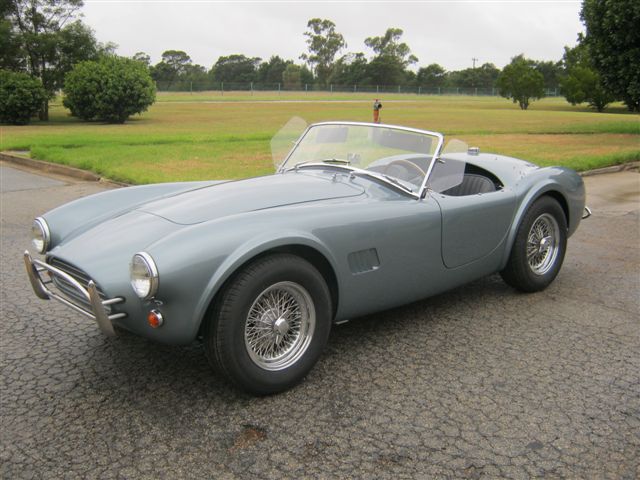
The Riverside roadsters bodywork replicates the later of the 289`s which incorporated modifications to fender flares so as to accommodate the slightly wider tires compared to the first 260`s.It comes standard fitted with chrome wire wheels.Different length pedals are also offered to accommodate different length legs